
Whiplash Symptoms That Show Up Days Later — and When to Get Checked
Short answer: Yes, whiplash symptoms often show up hours or days after a car accident, and sometimes longer. Adrenaline can mask pain at the scene, and inflammation and muscle guarding build over the following days. The most common delayed symptoms are neck pain and stiffness, headaches, shoulder and upper-back pain, dizziness, and fatigue. Some symptoms, such as severe headache, weakness, numbness, confusion or loss of consciousness, need emergency care right away. For everything else, getting checked within the first few days gives you a measured baseline and a clear plan.
Why symptoms can be delayed
You walk away from the crash feeling "mostly fine." Two days later, you can't turn your head. That pattern is common, and there are a few reasons for it.
Adrenaline. After a crash your body floods with stress hormones, which dull pain for hours.
Inflammation takes time. Injured muscles, ligaments and joints swell gradually, so stiffness often peaks a day or two later.
Muscle guarding. The muscles around an injured neck tighten to protect it, and that tightness can take time to become obvious.
Ligament injury doesn't always announce itself. Ligaments hold the spine's segments together. When they are sprained, the pain can be vague at first, and the injury often doesn't show up on a standard X-ray or MRI.
Symptoms that commonly show up later
Symptom | What it can feel like |
|---|---|
Neck pain and stiffness | Trouble turning to check your blind spot; pain looking down at a phone |
Headaches | Starting at the base of the skull and moving toward the forehead |
Shoulder and upper-back pain | Aching between the shoulder blades or across the tops of the shoulders |
Dizziness or unsteadiness | Feeling off balance, especially when turning your head quickly |
Arm tingling or numbness | Pins and needles in the arm or hand |
Low-back pain | Soreness in the lower back, sometimes with leg symptoms |
Fatigue and trouble concentrating | Feeling foggy or worn out for no clear reason |
Sleep problems | Can't get comfortable; waking with neck pain |
Jaw pain | Soreness around the jaw joint |
Not every symptom means a serious injury. But new symptoms after a crash are worth taking seriously, especially if they are getting worse instead of better.
Go to the ER first if you have any of these
Seek emergency care right away, before any chiropractic visit, if you have:
A sudden, severe headache or "worst headache of your life"
Loss of consciousness, confusion, repeated vomiting or a seizure
Weakness, numbness or loss of control in an arm or leg
Loss of bladder or bowel control
Trouble speaking, vision changes or facial drooping
Severe neck pain after a significant impact, or pain with any numbness or tingling that is rapidly worsening
If you are unsure, go. It is better to be told it's nothing.
A rough timeline of what people notice
This varies from person to person, so use it as a guide rather than a rule.
The first 24 hours: Stiffness or soreness, sometimes nothing at all.
Days 2 to 3: Pain and stiffness commonly peak. Headaches and dizziness may begin.
The first week or two: Symptoms may improve, plateau or spread to the shoulders, upper back or arms.
Beyond two weeks: Symptoms that haven't improved deserve an exam, not more waiting.
When to get checked
A good rule: get checked within a few days of the crash, even if you feel okay, and sooner if any symptom above appears. Waiting doesn't make you tougher. It can make the picture harder to read, because a baseline taken right after the accident is the clearest record of what changed.
An evaluation at our Clive clinic typically includes:
A detailed history of how the crash happened and any prior neck or back problems.
Measured range of motion of the neck, in degrees rather than estimates.
Orthopedic and neurological tests to check the nerves, reflexes and strength.
Questionnaires that score how the injury affects your daily life.
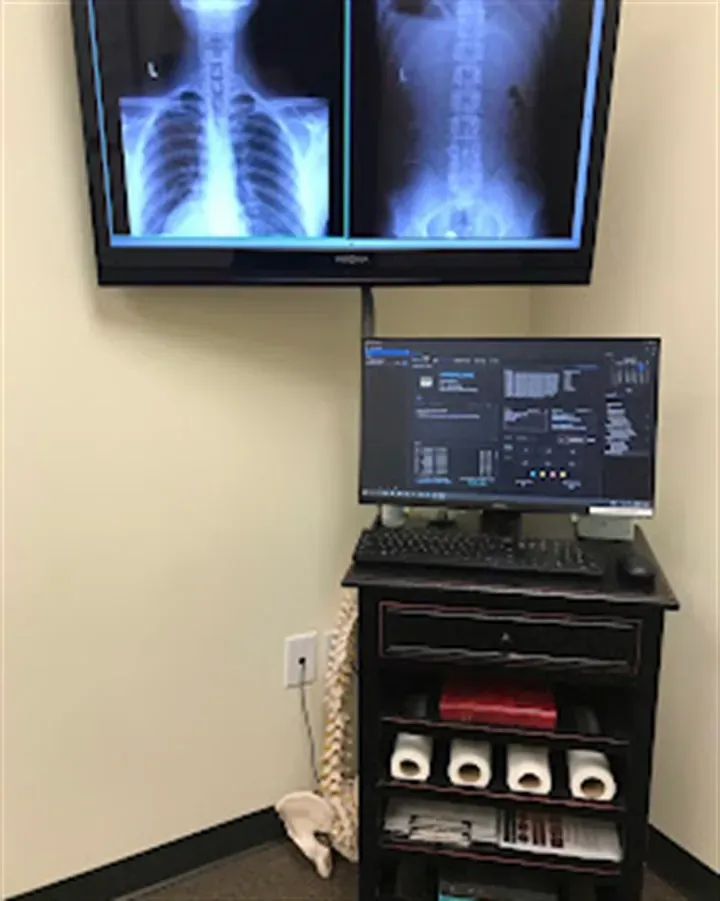
Imaging when it is warranted, including motion X-rays that show how each spinal segment moves. How motion X-rays document ligament injury →
A clear plan, including referral to an MRI, neurologist or another provider if your findings call for it.
What to do right now
Seek emergency care first if you have any red-flag symptom above.
Write down your symptoms as they appear, with dates. A simple note on your phone works.
Keep moving gently. Prolonged rest often makes stiffness worse; avoid anything that sharply increases your pain.
Don't rely on over-the-counter relief to "wait it out." If you need medication to function, you should be examined.
Don't sign anything you don't understand, and take your time with insurance conversations. If you have questions about your claim, an attorney can answer them. We can't give legal advice.
Book an exam if symptoms persist past a few days or are getting worse.
For a step-by-step guide to the first 72 hours, read what to do after a car accident in Des Moines.
Frequently asked questions
Can whiplash symptoms really start days after the accident?
Yes. Delayed onset is common. Pain and stiffness often increase over the first one to three days as inflammation develops.
How long do whiplash symptoms last?
It varies widely. Many people improve within weeks to a few months, and some have symptoms that last longer. An exam helps identify which pattern you are in.
Is it normal to have headaches after a car accident?
Headaches are among the most common whiplash symptoms, often starting at the base of the skull. A sudden severe headache, confusion or vomiting needs emergency care.
Will a normal X-ray rule out whiplash?
No. Standard X-rays mainly rule out fractures. Ligament and soft-tissue injury often don't appear on them, and may need motion views or other evaluation.
Should I see a chiropractor or a doctor first?
If you have any red-flag symptom, go to the ER first. Otherwise, a chiropractor trained in spinal injury can evaluate you, treat what falls within chiropractic care, and refer you for imaging or to another provider when needed.
Do I need an attorney to get checked?
No. You can be evaluated without one. Questions about a claim are for an attorney, not for us.
Hurt in a crash? We can see you this week.
Champion Chiropractic & Spinal Injury is at 11050 Hickman Road in Clive. Call or text (515) 777-1014 or learn more about chiropractic care for car accident injuries.
Justin Luneburg, DC, FPSC(C), is clinic director at Champion Chiropractic & Spinal Injury in Clive, Iowa, and a Fellowship Candidate in Primary Spine Care. More about Justin Luneburg. This article is general information and not medical or legal advice.