
How to Document Causation After a Motor Vehicle Crash: What a Defensible Chiropractic Narrative Contains
Short answer: A defensible chiropractic causation narrative links the crash to the injury using the same steps every time: the mechanism of injury, the timing of symptom onset, objective findings, the clinical reasoning that rules out other explanations, and a statement of what existed before the crash. It is written to the standard the provider is willing to defend under cross-examination, usually "reasonable degree of chiropractic certainty" or the standard your jurisdiction requires. Narratives that skip the differential or ignore prior history are the ones that get picked apart.
Causation versus diagnosis
A diagnosis says what is wrong. Causation says why, and whether the crash is a substantial contributing cause. Attorneys need both, and they are two different analyses. Many records are strong on diagnosis and thin on causation, because the second one requires the provider to explain their reasoning rather than list findings. The causation opinion is also where a provider's scope of practice and the legal standard in your state matter, so confirm with your jurisdiction's rules which provider types can offer an opinion and in what form. We are a clinic and this is not legal advice.
The elements of a defensible narrative
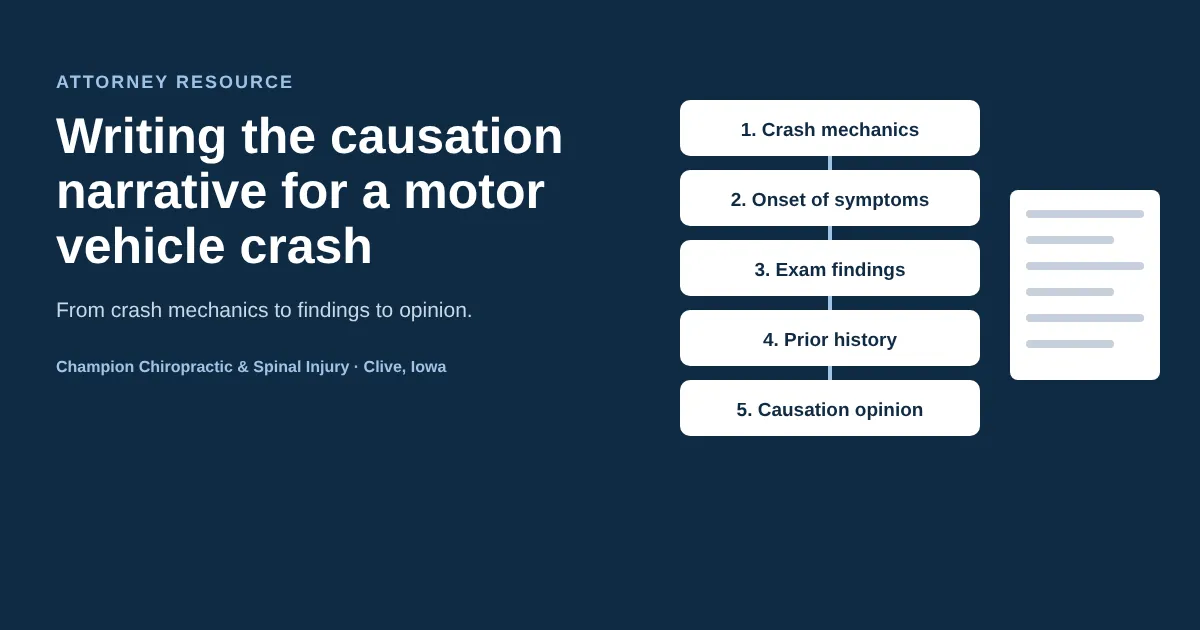
1. Mechanism of injury
What happened physically: vehicle positions, direction and approximate severity of impact, the patient's seating position, head position and restraint use, and what the body did. This is taken from the patient history and, where available, police and photo documentation. The narrative should describe forces and motion, not just "rear-ended."
2. Temporal relationship
When symptoms began, relative to the crash. Delayed onset is common and is not a problem by itself, but it has to be recorded honestly and explained, for example by adrenaline masking pain or by inflammation developing over the following days. See why whiplash symptoms are often delayed.
3. Objective findings
Measured range of motion, orthopedic and neurological findings, palpation findings with their level and side, outcome questionnaires, and imaging where indicated. Where motion X-ray is used, document the technique, the measurements and the comparison to published reference values. For how ligament injury is documented, see computer-measured X-rays and whiplash.
4. Prior history
Previous neck or back complaints, prior accidents, work history and degenerative findings. The narrative should not ignore them. The honest question is whether the crash caused a new injury, aggravated an existing condition or neither, and the record should explain how the provider reached that view. Defense experts look for this section first.
5. Differential diagnosis
Alternative explanations the provider considered and why they were set aside or ranked lower: degeneration, prior injury, a non-traumatic cause, a non-spinal source. A narrative without a differential reads like advocacy.
6. Clinical reasoning
Why the findings fit the mechanism. For example, a pattern of segmental restriction, tenderness and measured motion loss at the levels expected from the direction of force, with symptoms starting within the expected window.
7. Prognosis and apportionment, if applicable
Expected course, any residual impairment or permanency, and the portion attributable to the crash versus pre-existing conditions, when the provider is qualified to offer that opinion and the jurisdiction allows it. Many narratives overreach here. Stating the limits of an opinion strengthens it.
8. The standard stated
The opinion is expressed in the form the provider can defend. Typically "reasonable degree of chiropractic certainty," or the equivalent in your jurisdiction. Confirm this with counsel in each case.
What gets narratives challenged
Weak point | Fix |
|---|---|
Causation stated without reasoning | Show the steps, not only the conclusion |
No differential diagnosis | List what else was considered and why it was ranked lower |
Prior history left out | Address it directly and explain the view |
Copy-forward notes | Individual notes that reflect that day's findings |
Language that overstates certainty | Use the real standard and acknowledge limits |
Narrative written long after treatment | Build it from contemporaneous records |
Findings not tied to measurements | Numbers, not adjectives |
When to request the narrative
Ask for it when care reaches a natural decision point: at discharge or maximum improvement, before a demand, or after a significant change in the case. Asking earlier produces an incomplete one, and asking late produces a rushed one. Our usual timeline is covered in the documentation timeline attorneys should expect, and the record standards that support it are in what a chiropractic record needs to hold up in a whiplash claim.
Frequently asked questions
Is a causation narrative the same as an expert report?
Not necessarily. A narrative from the treating provider is a treating-provider opinion. An expert report is a separate retention with its own rules. Your jurisdiction determines the difference.
Can the treating chiropractor testify?
In many cases, yes, subject to local rules. Tell us early if a deposition or testimony is likely.
What if the patient had prior neck pain?
That does not rule out a crash-related injury. It makes the history and the differential more important.
How long does a narrative take?
It depends on the case and the length of care. Ask for the turnaround up front.
Do you opine on permanency?
Only when findings support it and the jurisdiction permits that opinion from our provider type.
Referring a client to Champion Chiropractic & Spinal Injury
We are at 11050 Hickman Road in Clive. Call or text (515) 777-1014 and mention that you are an attorney referral. Read more about the clinic director's training and credentials.
Justin Luneburg, DC, FPSC(C), is clinic director at Champion Chiropractic & Spinal Injury in Clive, Iowa, and a Fellowship Candidate in Primary Spine Care. This article is general information for attorneys and is not medical or legal advice.